
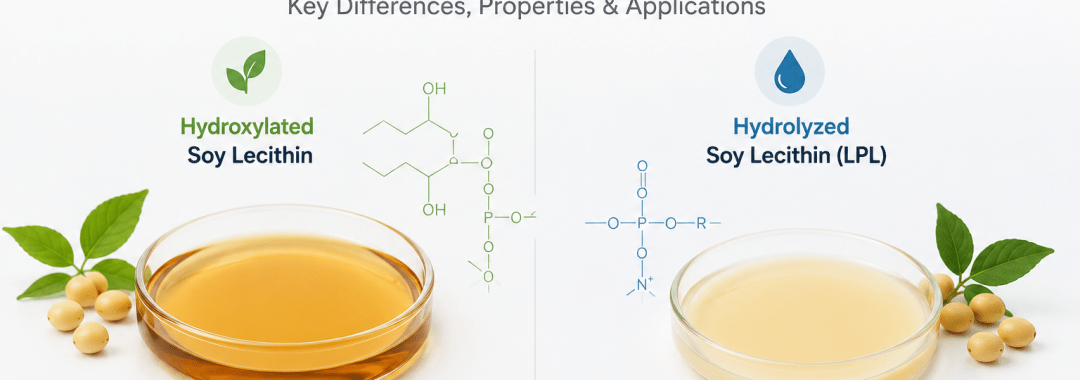
Hydroxylated Soy Lecithin vs. Hydrolyzed Soy Lecithin (LPL): Key Differences, Properties, and Applications
Soy lecithin is widely used in food, feed, agriculture, and industrial formulations due to its emulsifying and functional properties.
Two important modified types are Hydrolyzed Soy Lecithin (LPL) and Hydroxylated Soy Lecithin, which differ significantly in structure and performance.
1. Core Difference in One Sentence
Hydrolyzed Soy Lecithin (LPL): Phospholipids are enzymatically hydrolyzed (“cut shorter”) to produce mainly lysophospholipids (Lyso-Phospholipids).
Hydroxylated Soy Lecithin: Phospholipids undergo chemical hydroxylation, introducing -OH groups to increase polarity without significantly breaking the lipid backbone.
Summary: Hydrolysis = chain cleavage | Hydroxylation = functional modification
2. Structural Differences
Hydrolyzed Soy Lecithin (LPL)
Produced via enzymatic hydrolysis using phospholipase enzymes (e.g., PLA2), removing one fatty acid chain from phospholipids.
- PC → LPC (Lysophosphatidylcholine)
- PE → LPE
- PI → LPI
Structure changes from two fatty acid chains to one, resulting in higher hydrophilicity and increased HLB value.
Hydroxylated Soy Lecithin
Produced by oxidation or hydroxylation using peroxides or organic acids, introducing hydroxyl (-OH) groups while preserving the phospholipid backbone.
- Fatty acid chains become more polar
- No significant chain removal
- Higher molecular integrity remains
3. Performance Comparison
| Property | Hydrolyzed Lecithin (LPL) | Hydroxylated Lecithin |
|---|---|---|
| Molecular Change | Chain cleavage | No chain cleavage |
| Hydrophilicity | Very strong | Moderately improved |
| HLB Value | 12–16 | 7–10 |
| Water Solubility | Excellent, can form clear systems | Mainly emulsifying |
| Penetration | Very strong | Moderate |
| Stability | Lower | Higher |
| Odor/Color | Stronger | Milder |
4. Application Differences
Hydrolyzed Soy Lecithin (LPL)
Key Value: Absorption + Penetration + Bioavailability
- Animal nutrition (improves nutrient absorption)
- Functional emulsifiers (high-HLB systems)
- Agricultural adjuvants (foliar penetration enhancers)
- Pharmaceutical and nutraceutical delivery systems
Hydroxylated Soy Lecithin
Key Value: Stability + Emulsification + Compatibility
- Industrial emulsification (coatings, textiles, lubricants)
- General food emulsification support
- Mild modification systems
- Replacement of standard lecithin for better dispersion
5. Conclusion
Although both Hydroxylated Soy Lecithin and Hydrolyzed Soy Lecithin (LPL) are derived from natural soy lecithin,
they represent two completely different modification technologies.
Hydrolysis focuses on breaking down the molecular structure to enhance absorption and biological performance,
while hydroxylation focuses on improving polarity while maintaining structural stability.
Selection depends on application requirements: performance-driven systems prefer LPL, while stability-focused systems prefer hydroxylated lecithin.